Wednesday, February 13, 2013

The Sound of Inevitability


My street is incredibly steep and covered with very slick cobbles.  I was walking to school, minding my own business, when my knee dislocated and I fell.  I pushed the bone back in place and picked myself up.  At this point, I would have gone on to school but noticed that I couldn’t really move my left arm.  Instead, I went home and called the insurance company to tell them I needed to see a doctor.  Since this is Georgia, I was told to call back at ten when they opened.  When I called back, they told me just to go straight to the hospital. 

I didn’t know where the hospital in Telavi was, so I had to ask Lika for help while walking there.  She got an increasingly worrisome string of texts from me that morning.

Where is the Telavi hospital?
What is the Georgian word for pain?
What is the Georgian word for emergency?

If you can avoid it at all, don’t go to the Telavi hospital.  Dangling wires, puddles of unidentified liquids on the floor, patients on gurneys hanging out in the hallways, no heat, no running water. 

This is the main entrance


This is the radiology room
When I finally found reception (mimgheba, in case you ever need to know), I called the insurance company again and then handed my phone to the ladies behind the desk.  They went and found what I have to assume was the only English-speaking doctor in the hospital. 

First, I had to have an x-ray.  I was too tall for the table, so the tech told me to kneel so my elbow would reach.  Just dislocated my knee; that’s not happening.  A tiny old lady with arms like solid iron bars casually tried to force my elbow into the position she wanted while chatting with the other patient in the room over my muffled, bitten-off screams.  For some reason, they both assumed I was a German tourist.  There were no lead aprons, no screens to stand behind while operating switches, nothing.  She even told me to stay in the room while she x-rayed the other lady’s chest.    

While the x-ray was being developed (or they all went out for a cha-cha break… I’m not too sure which), I waited out in the freezing cold hallways and watched the guy in the cast room ahead of me bleed all over the table.  The nurse wiped the table down with a rag and then called me in and told me to hop up.  I did so, praying that I didn’t have any scratched on my arm I was unaware of.  Doctor Zurab told me that I had broken my arm.  Yippee. 

The very latest in Ladies' Fashions

I am now casted from my palm to my bicep, in a really scratchy plaster cast with no padding at all.  Doctor Zurab demonstrated his pretty incredible English by warning me about muscle atrophy and range of motion loss.  He tried to demonstrate how best to manoeuvre with the cast, but kind of trailed off when he saw how easily I was putting my jumper on and grabbing my coat.  I’ve had a bit of practice with just one arm. 
I stopped on my way home to show Lika that all was ok, just a broken arm and a very sore knee.  No need to put ice on either; all I’ll have to do is pull the blankets off while sleeping tonight. 

The only thing I can’t seem to do with one arm is fix my own hair.  Ani loves this – she gets to brush and plait my hair for me every morning.  Yesterday, she decided to count all my grey hairs while she brushed.  Apparently, I have a lot of them.


Update: cast is off and arm is doing just fine.

Thanksgiving in Telavi


Emma offered to let us have Thanksgiving dinner at her flat on Giorgoba, which was the day after Thanksgiving this year.  The non-Americans on the guest list outnumbered the Americans, which was fun.  Everyone cobbled together some sort of Thanksgiving dish from what they had available.  Kelsey volunteered to bring the turkey, which conjured up  images of Kelsey chasing the bird around her yard with a giant knife.  The Irish people were in charge of the mashed potatoes, of course.


I bought half a pumpkin for pie, but I’d never actually used raw pumpkin before, so I didn’t realize it would make so very much.  Three pies, with enough filling left over for pancakes.  My first ever batch of eggnog from scratch turned out pretty well.  I tried to make mac and cheese, but the cheese was all wrong and the milk was too thick to be absorbed properly.  It was still pretty tasty but nothing like my mother-in-law’s.

There was so much food, and all of it slightly improvised with Georgian ingredients.  Emma made a pecan pie with no pecans.  Amy made a green salad without any lettuce.  Shawn just brought lots and lots of wine that his host family made.


We all stuffed ourselves while listening to Christmas carols.  After, we played charades.  Since we’d all had so much practice trying to communicate with host families, market clerks, marshrutka drivers, and everyone else in this country, we were all pretty fabulous at it. 

It was the best American Thanksgiving the South Africans, Canadians, Irish, Georgians, and Brits had ever had!

It was Benjami's first and best Thanksgiving!

Guy Fawkes Night

Olly, being the good Queen’s subject that he is, tried to teach his students about Guy Fawkes’ night.  To most people, this would mean showing some pictures, perhaps translating a passage about English history.  To Olly, this meant writing and producing a three-act play and then building a bonfire.  He even got special dispensation from the Georgian Orthodox Church to burn an effigy of Guy Fawkes.  This was something that needed to be seen to be believed, so I went off to Samegrelo.


I took the midnight train from Tbilisi to Zugdidi, the capital of Samegrelo, which was surprisingly comfortable.  Marshrutkas all seem to be built for Georgian size people, which means my knees are always jammed into the back of the seat in front of me.  Not only was there plenty of leg room on the train, I could actually recline my seat.  In fact, I slept the entire seven hour ride north. 

Zugdidi just after sunrise

I arrived in Zugdidi just in time to see the sun rise and immediately started playing my favourite game: How Many Georgians Does It Take to Put Me on the Right Marshrutka?  Zugdidi now holds the record for this game at fifteen.  Eventually, I was on a marshrutka the driver assured me was going to Chorotskhu and passing Zumi.  An old lady sitting next to me said she knew Olly, that her grandchildren were his students.  She gave me a tourguide’s commentary on all the scenery we passed and told me which mountains were Samegrelo, which were Svaneti, and which were Abkhazia. 

The ones on the left are Svaneti.  Straight ahead is Abkhazia

Despite the driver’s assurances, I think I was still on the wrong marshrutka.  Or the driver got lost.  Olly and Tom both told me that the ride from Zugdidi to Chorotskhu should take less than an hour.  It took us three.  Finally, after many confusing phone calls between Olly, his co-teacher, the driver, and myself, I saw Olly sleeping by the side of the road where he was waiting for me. 

In preparation for the Guy Fawkes play (and the other surprise), his school had more or less cancelled classes for the day.  We walked into absolute chaos.  Some of the students were pretending to practice their lines, some were playing with the speakers, several were chasing each other around with the prop swords and spears, and a few decided to test out their home-made fireworks.  After all, it wouldn’t be Guy Fawkes night without explosions in school?

Olly, the Guy, the history teacher, and a future wife of Henry VIII

The show was supposed to start at 6, but Olly got a call around half past two informing him that the play was about to start and he was needed back at the auditorium.  It was still another hour or so before the curtain went up.

In the meantime, chaos!

The play itself was pretty impressive.  Olly started his script all the way back with Henry VIII to put the religious and dynastic arguments in context.  I think just about all the students in the upper three grades played some part on stage.  Most of the students had their lines and blocking fairy well memorized, and the scenery and props were very creative.  My camera died about halfway through the show, so I didn’t get any pictures of the climactic battle under Parliament or the dramatic trial scene (with much brandishing of swords and shaking of spears). 

Queen Elizabeth with one of her Ministers and a Georgian reporter
There were reporters from two different Samegrelo news stations there, videotaping the whole thing.  I think it’s supposed to be up online someplace, but I can’t find it.  Between the cameramen walking around onstage in front of the actors and the audience (mostly the younger students, who don’t really understand English yet) talking throughout the show, it was a little difficult to hear what was being said sometimes.  From the other shows I’ve seen in this country (plays, concerts, dance recitals), that seems to be pretty much par for the course for Georgian audiences.  Everyone still seemed to enjoy it.

After Olly’s play, we were informed that the students had put together an exhibition of Georgian culture, and we were to be taken on a tour of all seven regions.  I was dragged into this because I was there.  If Tom hadn’t been stuck in a marshrutka, I’m sure he would’ve been taken on tour as well.  Olly and I were told to follow our ‘tour guide’ around the cafeteria and smile and look pretty while the reporters got to videotape the whole thing.  We’re on the Samergrelan news somewhere, Olly looking smart in his suit and tie and me in the clothes I’d slept in on the train.  Oh, Georgia…

Apparently, their school isn't always decorated like this

It was a neat exhibition, though.  For each of the seven regions of Georgia, the students put on a skit or sang and danced or something to showcase that region’s specialty.  Kakheti (where I live) was all about food and wine.  No surprise there.  Olly was afraid we’d have to, as he put it, “get pissed through all seven regions,” but the students drank all the wine themselves.  We didn’t even get a chance to get pissed until after.

When the kids were done with all the regions, the reporters shoved microphones in our faces and asked us what we’d thought of it all.  Olly, accustomed to being a local news star, gave some brilliantly diplomatic response about the value of education and cultural exchanges.  I stuttered so badly they thought the microphone was broken and finally stammered out something about Georgia being beautiful. You can watch the video here.  Footage from the play starts around three minutes in, and the cameras following the crazy foreigners starts around six minutes in.

But we weren’t done yet!  Not by a long shot.  Before the bonfire could be lit, we had to have a proper supra.  All the food that had been made to represent each region for our tour was brought out to the table and put in front of us.  The tamada compared Olly to Shota Rustavelli and William Shakespeare, then made lots of very long toasts to knowledge and art and future generations.  Olly’s co-teacher, who had been translating the toasts, eventually just told us that the tamada was using lots of words to say nothing and gave up translating.  Just in time for dessert, Tom strolled in.  He has exquisite timing.

The local priests weren’t keen on the idea of burning effigies of people, but Olly had somehow convinced them to let him thrown the Guy Fawkes he’d made on the bonfire.  There were lots of pictures, lots of bits of mangled English poetry, and lots of sparks flying.  The Girl Scout in my head was shaking her fist at the lack of fire safety, but she seemed to be the only one who cared.

Nino, Olly’s host sister and one of the dancers on our tour, gave me a lesson in Georgian dancing while we were waiting to go to the train station.  Unfortunately, I’m too tall to be her dancing partner.  Phooey.  Dato and Datona drove me to the Zugdidi train station, but I had misremembered the departure time and missed the train by half an hour.  No matter: they then drove me to the next station on the line, Senakhi, in time to catch the train there.  After another night sleeping sitting up, a frantic subway ride, and a desperate bout of trying to read the correct marshrutka sign in Georgian, in the dark, while moving, I made it back to Telavi in time for my first class on November the Sixth.  Just barely.

Mstkheta


Mtskheta used to be the capital of Georgia, and it’s only about a twenty minute ride outside of Tbilisi.  On an interesting side note, the name Tbilisi comes from the Georgian word for “warm” because of the hot sulphur baths in the city. 

The marshrutka let us out in front of this museum or whatever it was.  Lovely mosaics and bas relief sculptures.  Not so lovely smell.  Apparently, it’s been used as an open-air public toilet for a while. 


Down the street a bit, we found a touristy spot that looked a lot like the Germany section of Busch Gardens.  We made our way down to the river, where the Aragvi and the Kura Rivers meet.  I couldn’t get a decent picture of it, but this shot from a tourist website shows it pretty well. 


On our way up to the ruins of the old castle, we passed an actual, bona-fide jogger on the road.  This was such a strange occurrence that we couldn’t help but stare at him as he passed.  People in Georgia don’t go jogging.  Ever.  Must have been an American.

We also passed this sign, which was about as strange as the jogger.  Naturally, the sign asking people not to litter and to keep Georgia clean was surrounded by trash.  Go figure.


The ruins had warnings about land slips, but we like to live dangerously.  The view from the top was lovely.  Off in the distance, we could see the Jvari Monastery. 


The biggest building in Mstkheta by far is the Svetitskhoveli Cathedral where the Robe of Christ is said to be buried with Saint Nino.  Inside, it was much lighter than most of the churches I’ve seen in Georgia as well as quite a lot bigger.  The walls are almost completely covered in frescoes, and most of the former rulers of Georgia are buried somewhere beneath the floor.  There was a Eucharist service going on while we were there, and we were able to hide in the back and listen to the choir singing their amazing Georgian a capella polyphony. 


As we were eating the requisite khatchapuri and lobiani outside a café (being eyed by some very hopeful lstray dogs), we watched people being given rides in a horse-drawn carriage.  Kelsey says that Mtskheta reminds her of Mackinaw Island in Michigan.  There are hardly any cars, everything is very close to everything else, and the whole place has an air of being somehow removed from the rest of Georgia.  I’ve never been to Mackinaw Island, but it sounds like a pretty nice place. 


Kelsey had to head back to Apeni when we got back to Tbilisi, but I was going to Ani’s dance recital that afternoon.  She does traditional Georgian dancing, and her troupe was performing with a bunch of other schools from around the country.  I got lost trying to find the theatre, so I was late (as usual). 

When I finally found the theatre, I couldn’t actually find the audience and the stage.  I wandered around backstage, passing dozens of little girls and boys in dancing costumes with lots of makeup.  It was exactly like my ballet recitals when I was a kid, except with more bangles and less tulle.  At one point, I almost walked out on the stage itself. 

Dancers were there representing each region of Georgia, each with its own distinct style of music and costume.  Some of them whirled around the stage like dervishes in bright skirts; some of them glided slowly and smoothly across the stage in long, formal gowns.  There were, of course, lots of tiny boys in giant, fluffy hats.  Forget running with scissors; these kids were dancing with knives.  And flying. 


I think one of these girls is Ani
When all was done and Ani was on her bus back to Telavi, I went back to the hostel to wait for my train to Zugdidi at midnight.  While waiting for midnight, I tried to explain to the Italian guy there who doesn’t speak English or Georgian that I really can’t explain the conflict in Northern Ireland with pantomime.  It was a strange evening.

Monday, January 14, 2013

Gori


Kelsey S and I went to Gori on Saturday.  Gori is the birthplace of Joseph Stalin, and it’s only about an hour’s marshrutka ride from Tbilisi.  Keley’s term is up at the end of December, so she’s trying to make the most of every weekend and check off all the places she wanted to see in Georgia before then.

We had to catch the marshrutka from the Didube metro stop, which meant that we had to run the gauntlet of eager taxi drivers to find the right bus.  It’s kind of amazing (and a bit scary): as soon as we step out of the metro station, we are always surrounded by men trying to block our path and shouting the names of popular destinations at us.  “Batumi!”  “Kutaisi!”  “Rustavi!”  “Gori!”  If we hesitate or look the slightest bit interested, the drivers will try to pull us over to their cars and put our bags in the boot.  This happens at all the big metro and marshrutka stations; we must be doing something that just screams “sucker” to everyone we pass.

When we found the legitimate marshrutka to Gori, it was parked beneath a sign that said “Gori” and beside the ticket counter.  No shoving and shouting drivers involved. 


We had a look at the Stalin Museum first, but neither of us wanted to pay fifteen lari to look at pictures of Joe.  The lobby of the museum was really pretty, and they had a gift shop where we could buy coasters and flasks with pictures of Stalin on them.  There were even t-shirts with CCCP and Stalin slogans on them. 
Honestly, the outside of the museum was probably more interesting than the inside.  This is the super-heavily armoured railway car that Stalin rode around the country in. 

Somebody had trust issues...
According to what I could read of the plaque on the wall, this is the house where Stalin was born.  They built a shell around it that looks an awful lot like a temple. 


I’m not sure what these statues were below the ruins of the fortress on the other side of the city.  There was a small shrine sort of thing off to the side with little niches for candles. 

I have no idea why they're missing bits.  They were like that when we found them, I swear!
In true Georgian fashion, the police officers across the street didn’t even care that Kelsey and I climbed up on the artwork to take pictures. 

Don't mind me, just climbing on your monuments.

On our way up to the fortress, we got a bit lost and wound up walking all the way around it.  But we found this statue on the way.  

I'm not sure who he is, but he doesn't look very comfortable.
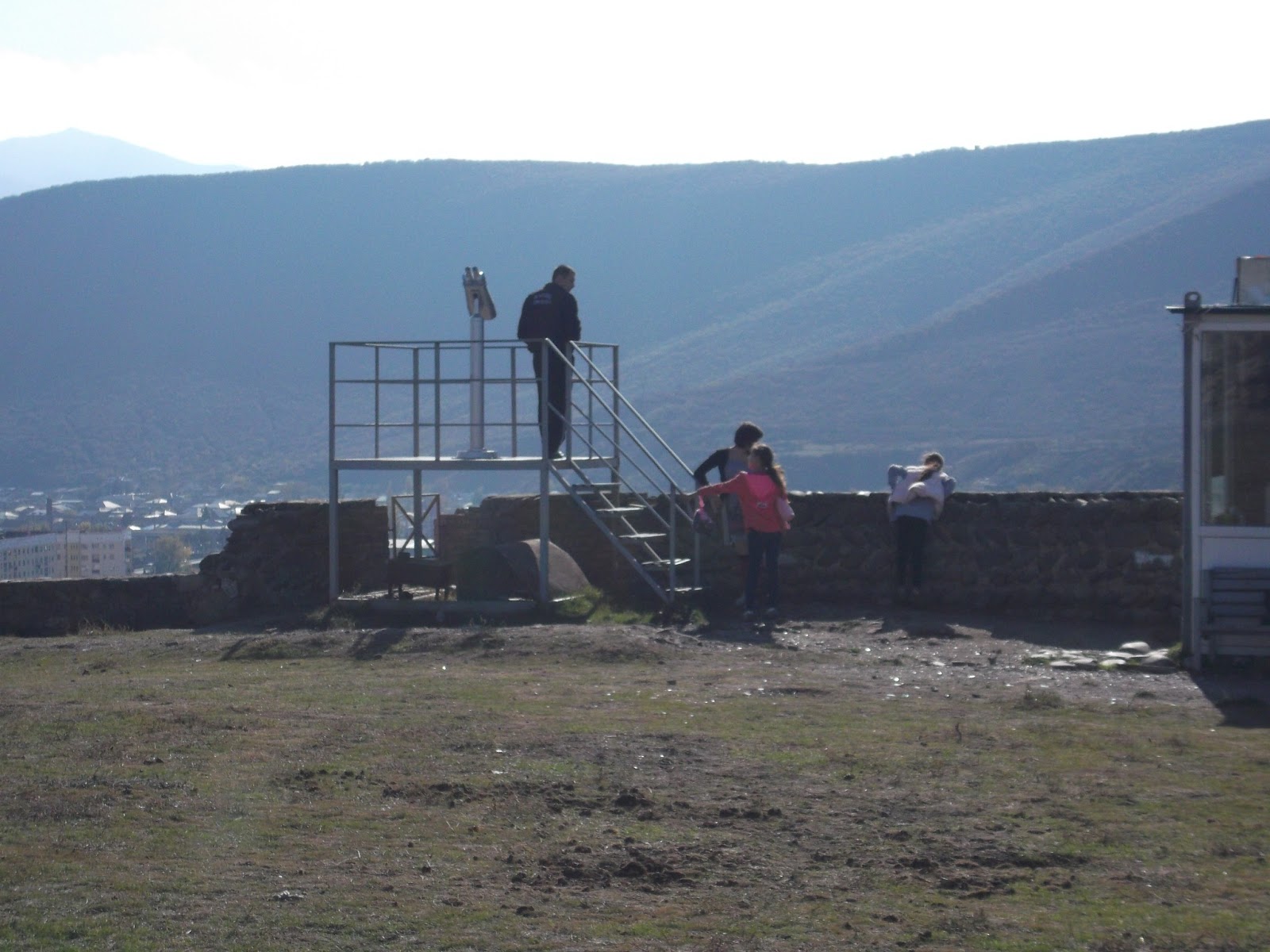
The fortress used to provide a vantage point for defenders of people who were trying to invade the city.  Now, the fortress provides a vantage point for police officers who like to watch people with their super- strong telescopes from the top of the walls.  

Still, we did get a fabulous view of the mountains in the distance.  


Kelsey and I tried to find a different way down for the return trip.  After clambering down slippery rock slopes and massive erosion through what used to be a terraced set of rooms leading up to the top, we hit a dead end.  No outlet.  Oh, well.  We both got a pretty good workout climbing back up. 


I’ve tried many different kinds of kinkhali over the past few months, but I finally got a chance to try mushroom kinkhali.  Kelsey and I stopped in a tiny little café and impressed the waitress so much with our ability to say hello in Georgian that she made us mushroom kinkhali even though they were technically not available.  They were pretty spicy, but totally worth the wait. 

In 2008, Gori was right in the middle of the hostilities between Georgia and Russia, and the city still has some scars.  On Stalin Street, many of the buildings still have bullet holes in the outer walls.  Some places looked like someone just went crazy with a machine gun, like this one.  It was a morbid kind of tourism, but we couldn’t stop ourselves from taking loads of photos.  

Those black spots are not dirt.
Rather than taking a regular marshrutka back to Tbilisi, we would up in a giant bus.  There was lag room and everything!  In the evening, I went souvenir shopping with both Kelseys in Old Town Tbilisi.  We stopped for the best ice cream I’ve had in Georgia and then found a place that made fairly passable lo mein and fried rice.  All in all, it was a very good day for my belly.

A Break from Khatchapuri


This weekend was so busy and so crazy that I think each day deserves its own separate entry.  It all started calmly enough with a marshrutka ride to Tbilisi on Friday afternoon.  I had made the mistake of washing my laundry on Friday morning, so I had to wait for things to dry before I could pack them.  There are times when I miss having a clothes dryer. 

Kelsey and Shelley were waiting for me at the hostel, and Shelley’s friend Sati took us to the best Indian restaurant in Tbilisi.  According to Sati, there is one other Indian restaurant in the city, but their chefs are from Pakistan and Bangladesh.  I’m pretty sure I wouldn’t be able to taste the difference, but Sati insisted. 


The restaurant looked really neat on the inside.  Each table was set up like its own little tent, with curtains separating diners from the rest of the restaurant.  The benches had lots of little throw pillows that were surprisingly comfy, especially after we ate so much we all got The ‘Itis. 

It was like the fajitas all over again.  I’m so used to being able to get food from just about any country in the world without ever leaving Richmond, and I really miss that variety over here.  Georgian food is good, but I miss lo mein and lasagne. 

I don’t even remember the names of what we ordered, except for the naan and samosas.  Something with lentils and curry, something else with cheese and cashews and raisins, something with rice and tomatoes.  It was amazing. 

Shelly and Sati and loads of food

For those of you who are confused, The ‘Itis is what you get after stuffing yourself, when you just want to lean back and close your eyes for a minute.  I think it’s only supposed to happen after eating Soul Food, but I’m hoping an exception can be made for a bunch of expats who’ve had too much khatchapuri. 

Wednesday, October 31, 2012

Espresso, the Play


My school director invited me to join the other teachers at a play on Saturday night.  I’m not sure if he said a Georgian play in Spanish or a Spanish play in Georgian.  Since I’d be lost either way, I figured it didn't much matter which one it turned out to be. 

This is the poster outside the theatre.  In context of the play I saw, it still makes no sense. 

There was a guy who was supposed to be writing music, I think.  And a man with red shoes and a cape.  And a lot of people wearing black and white who seemed to like attacking the other man.  And a girl wearing very short shorts and very big boots. 

The best part of the play was the music.  I’m pretty sure that the person picking the music didn’t actually speak English.  When there was a very scary and ominous creeping of the chorus across the stage, they played this music.  Fast forward to about 2:09.  When the chorus became a horde and overwhelmed the main character and dragged him off stage or piled on top of him or tore him to pieces, we heard the cheery refrain of the Ukrainian BellCarol

You now know as much about what happened on stage as I do. 

Hurray for bonding in the workplace!